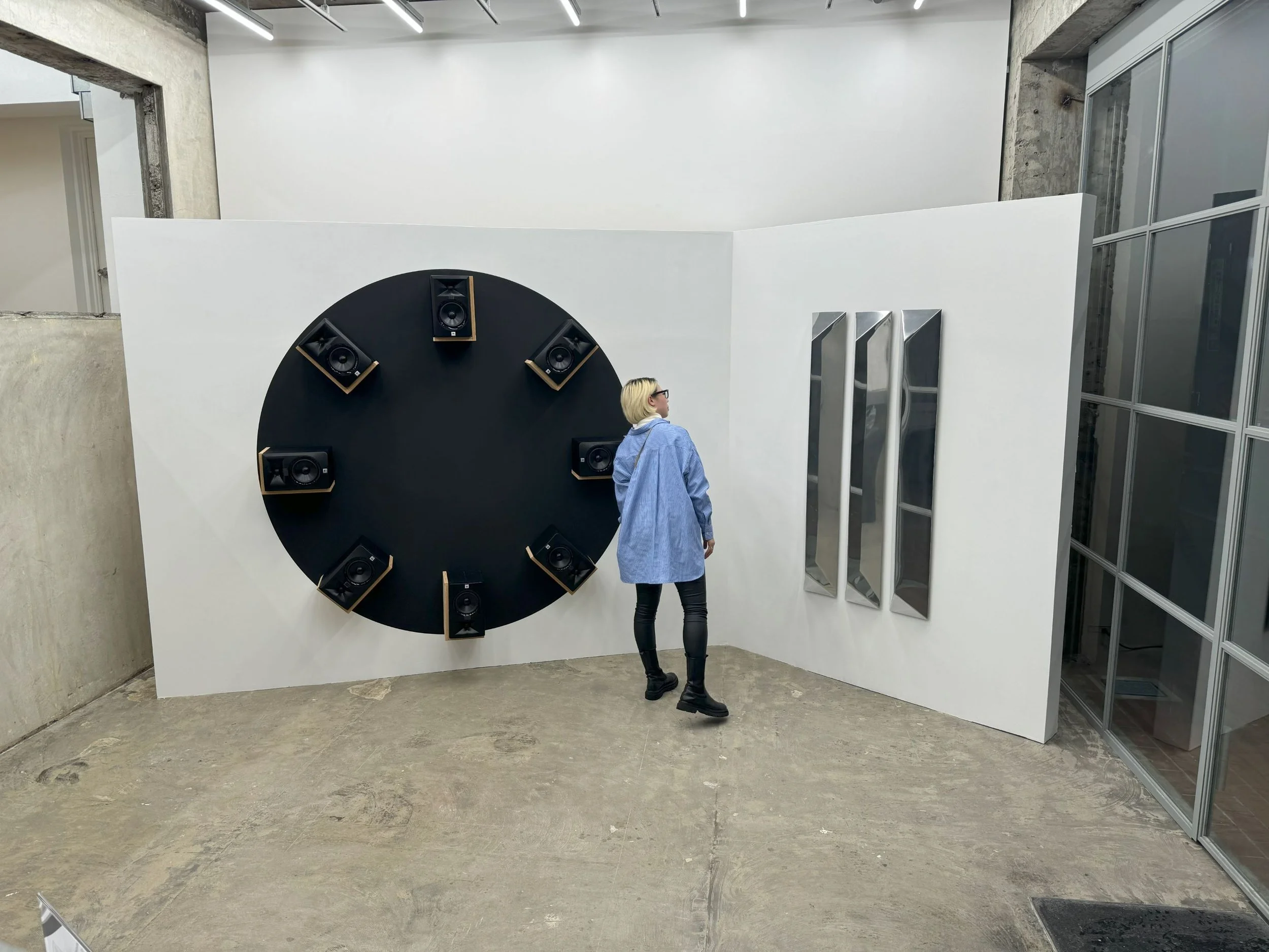
Wolfgang Gil (CV) is a New York-based Venezuelan sound artist who creates sonic environments through the use of computer-generated sound and multichannel speaker systems. Gil’s aesthetic emphasizes the idea of a sonic environment and its physical correlation to sound, architecture, and audience. More specifically, he is interested in the transformation of sound as a direct consequence of architecture, as well as how audience members transform the sound by their physical presence inside the sonic environment (more…)

Featuring Gill Arno, Patrick Franke, Richard Garet, Wolfgang Gil, Andrew Lafkas, David Moscovich, Daniel Neumann, Ben Owen, Chris Weinheimer, and others.

The group will explore collaborative strategies of composing and performing sound and visuals based on the idea of modular organization. Pieces are developed in non-hierarchical and decentralized forms where collaborators interact as equals. The modular structure is reflected less on the technical level but primarily on the level of collaborative formulation of ideas and its execution.

More info

http://www.brownpapertickets.com/event/214702

Diaphanspectrum represents a collective effort to explore the mind’s ability to interpret different sensorial stimuli as one, resulting in a unified multi-sensorial experience. Employing distinct mediums indistinctly, this sculptural installation includes computer generated, multichannel sound components as well as generative video. Beams of light shoot through a complex of fiberglass structures, creating a series of reflected projections, organically transformed through their display. While viewing this work, visitors will experience a synesthetical state- their sensory perceptions melting into one another, immersing them in the sculpture’s audiovisual output.

http://www.bringtolightnyc.org/

22 Recordings: In Circular Symmetry is a work of indeterminacy created by Richard Garet and Wolfgang Gil using Gil’s ROctoR (Real-time Octophonic Router). For this piece, Garet proposed and initial model to randomly reproduce 22 recordings he composed through different processes. This model was extended and refined through a process of collaboration between both artists. Finally, Gil translated the model into a MAX/MSP application that in conjunction with Richard’s sonic material and Gil’s ROctoR conformed the piece.

To play the piece ROctoR selects each audio file randomly. Within the duration of the selected track a segment, that is the 10% of the total duration of the track, is played back. A series of panning presets consisting of shapes such as a triangle, a square, a circle, and a line were created and assigned randomly to each sound. During the play back of each audio file the duration of the audio file is divided by the amount of parts of the panning shape and that determines the form of the panning movement. Additionally each panning preset was designed to keep changing position randomly.

The material for this work consists of utilizing, as a source, the sound from eleven audiocassettes tapes. These tapes were submitted to processes of deterioration such as data corruption, erasing, magnetic interference, and tape feedback. The sound that resulted from these processes were played back at various speeds and methods, and then digitally recorded. Each recording from the tapes was cut and spliced digitally by making editorial decisions and erasing the non-desired sections of the recordings. As a conclusion Garet arrived to a final number of 22 audio files. All audio files are different in duration and content.

As a conclusion an extensive number of possible configurations of structure, form, material, and movement will emerge from real-time process, creating not only a listening environment but also awareness of location, physical movement, and a surrounding sensorial experience. 22 Recordings: In Circular Symmetry will play indefinitely once it is initiated. However, to fit the program of the exhibition the work was prepared to play for 17’ at the time. However, even when it isn’t playing it will continue to run, changing configuration, until RoctoR initiates it again after the other three works have conclude their playback.

The result of a yearlong shared investigation between sound artist Wolfgang Gil and video artist Justin Riley, Reactive Homeostasis, generates interactive conversations through technology. Together the artists are developing an audio-visual system where both mediums are interconnected in a continuous feedback loop. This constant state of feedback between mediums imprints a chaotic character into the system, which becomes a third agent operating on its own; a digital Frankenstein monster. Searching for a stable equilibrium, Gil and Riley attempt to control the ratio of tension and release throughout their multi-media dialogue in order to keep the ‘monster’ within the desired boundaries while improvising an exchange of computer-generated sound and generative video immersing the audience in an environment of organic transforming projections and multichannel sound. Ultimately, the performance will push the boundaries of collaboration between human and machine, through a synthesis of audio and visuals.

Sunday, May 8 at 6:30pm and 7pm
FREE
Harvestworks – www.harvestworks.org
596 Broadway, #602 | New York, NY 10012 | Phone: 212-431-1130

POINT PLAY curated by Nisi Jacobs:
Octophonic Installations by Michael J. Schumacher, Richard Garet, Adam Kendall, Wolfgang Gil

POINT PLAY invites four artists (Schumacher, Garet, Kendall, and Gil) to compose individual works through an interaction with Wolfgang Gil’s ROctoR (Real-time Octophonic Router), a new custom software instrument designed for multi-channel sound diffusion. Enabling the creation of 8-channel soundscape compositions based on prerecorded or live sound, ROctor allows the ability to dynamically assign sounds to a selected set of speakers, and transition seamlessly to subsequent configurations, simulating the sensation of physical movement in space. In Schumacher’s work Sledge, for example, the composer spatializes sounds from sources such as

“films, including The Exorcist, The Sentinel, The Dungeonmaster and The Birds / Arp, EMS and Buchla synthesizers /
poet Bruce Andrews imitating the sounds of another of the composer’s installations / workers hanging a theatrical curtain / a wooden toy car / a skipping CD / stones tossed into a lake / the composer playing guitar / a Ferrari.”

The cycle of sound works from the four artists plays each Saturday of December on the 8-channel ROctoR system in the Gallery room at Diapason for extended immersive listening.

Richard Garet’s Rupture: Material Landscape consists of a single video channel, presenting a moving image piece originating from treated and processed 16mm film. Accompanying the moving image presentation Garet prepared an aleatoric sonic system based on sounds recorded from processed and modified audiocassette tapes. Garet invited Wolfgang Gil, a programmer and sound artist, to execute the aleatoric system with Max/MSP and Gil’s custom-made software Roctor. Gil will distribute Garet’s sonic material throughout the overhead multichannel audio system during the presentation of the footage. Garet also invited, as a special guest, interdisciplinary artist Bonnie Jones to contribute to the piece with live text and voices, which Wolfgang Gil will also be spatializing throughout the overhead multichannel sound system.

Follow

Get every new post delivered to your Inbox.